Cooking oils are a staple in kitchens worldwide, yet they’re often misunderstood. One day, an oil is labelled a superfood, and the next it’s called toxic or unhealthy. With so much conflicting information online, it’s easy to fall for myths that aren’t backed by science.
Let’s have a quick look at common cooking oil myths and what actually matters while choosing cooking oil.
Myth 1: All Fats and Oils Are Bad for You
For decades, fats were blamed for many health problems, which led people to avoid oils altogether. It is one of the common cooking oil myths, but the truth is that fats are an essential part of a balanced diet. Cooking oils provide fatty acids that help the body absorb vitamins like A, D, E, and K in a better way.
Fact: Not all fats are the same. Harvard Health suggests replacing bad fats, also known as trans fat, with unsaturated fats such as MUFA and PUFA. The solution isn’t avoiding oil but choosing the right ones and using them in moderation.
Myth 2: Expensive Oils Are Always Better
Expensive oils are often perceived as premium. But the truth is, it could be premium in price but not in quality.
Fact: Price doesn’t guarantee quality or health benefits. Some affordable oils are excellent for everyday cooking, while some expensive speciality oils are best reserved for finishing or flavour.
Reading labels and understanding oil composition is better than looking at the price.
Myth 3: High Smoke Point Means Healthier Oil
Many people assume that oils with high smoke points are automatically healthier. While smoke point is important for choosing an oil for certain cooking methods, it doesn’t determine nutritional value.
Fact: There is no scientific study that proves that a high smoke point means better performance and stability. Oil’s safety and stability depend more on the saturated fatty acid percentage.
You should have a balanced approach to both smoke point and overall fat composition.
Myth 4: Coconut Oil Is a Miracle Health Food
Coconut oil is gaining popularity as a superfood, but it’s often overhyped. While it can add flavor and works well for certain recipes, using it for all dishes is a big mistake.
Fact: Coconut Oil contains 92% saturated fat, which means that if taken in excess, it can lead to a bad cholesterol level in your body.
Instead of relying on coconut oil for every dish, you can use it occasionally.
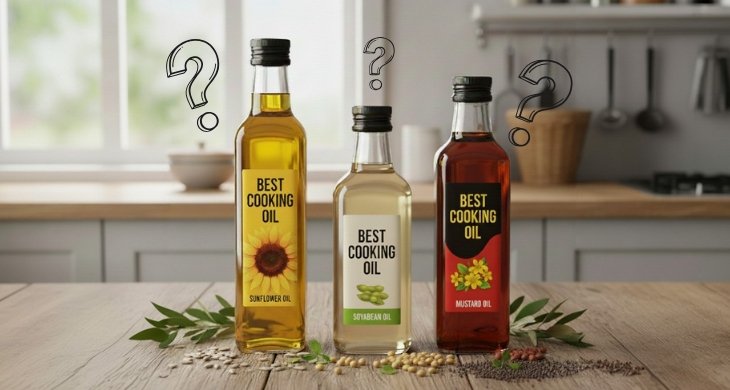
Myth 6: You Should Only Use One “Best” Oil
Many people use only one oil for every cooking method and dish. They often think that it is the perfect way to achieve balanced nutrients,
Fact: There is no single oil that is suitable for every cooking type. In fact, oil rotation works best. Using different oils for specific cooking methods can provide a wider range of flavours and nutrients.
Instead of searching for one ‘perfect’ oil, it’s better to match the oil to the cooking method and recipe.
Conclusion
Cooking oils don’t need to be scary or confusing. Most myths come from oversimplified health trends or misinformation. By understanding the basics like fat types, smoke points, and moderation, you can make informed choices without stress.
At the end of the day, a balanced diet, reasonable portions, and variety matter far more than avoiding or obsessing over any single oil.
Start cooking smarter today and choose oils based on facts, not food fads. Share this with everyone and make them aware too.