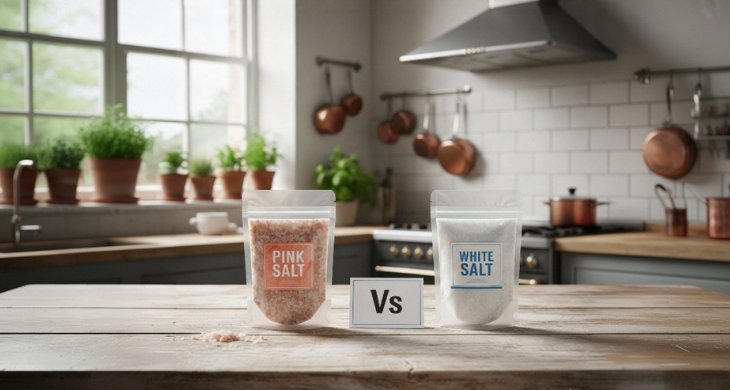
Which One Is Really Better?
Salt is a meal necessity. Without salt, the food tastes too plain. But do you ever find yourself stuck in choosing between pink and white salt? Well! Each is different and varies in health benefits. Let’s take a quick look at these salts.
What is White salt?
White salt is also known as table salt. It is mainly refined sodium chloride (NaCl), which is processed from underground deposits or obtained from the evaporation of seawater. In the process of extraction, most of the natural minerals get removed, leaving behind almost pure Sodium Chloride. Later, iodine is added to the salt.
Benefits of White Salt
- Prevention of Iodine Deficiency Disorders: In India, approximately 167 million people are at risk of iodine deficiency disorders, with 54 million having goitre, 2.2 million with cretinism, and 6.6 million with mild neurological disorders. Since white salt contains sodium chloride, it helps prevent such disorders.
- Affordable and accessible: It is comparatively more affordable since it is produced in large quantities using an efficient extraction method.
- Cognitive Development Protection: Children born in iodine-deficient regions, on average, have 13.5 intelligence quotient points less than children born in iodine-sufficient regions, as per IJMR (Indian Journal of Medical Research). Consuming white salt enhances cognitive development among children.
What Is Pink Salt?
Pink salt is also called Himalayan salt. It is chemically similar to regular table salt but is less processed and contains small amounts of minerals like potassium, magnesium, and calcium. White and pink salt differ in content composition. While white salt is fortified to make it iodine-rich, pink salt lacks iodine. But it’s popular in health-conscious kitchens and is often marketed as the purest salt available in the market.
Benefits of Pink Salt
- Naturally Rich in Trace Minerals: Pink salt gets its colour from natural mineral content, including iron oxide and small amounts of calcium, potassium, and magnesium.
- Less Processed & Additive-Free: It is typically mined, washed, and ground without chemical additives or anti-caking agents, which makes it a cleaner and more natural choice for meals.
- Enhances Flavour Naturally: Its delicate, clean taste and coarse texture make it perfect as a finishing salt while elevating dishes with a subtle flavor.
Note that there is not much scientific evidence that strongly claims the health benefits of pink salt. So it can be used for taste preference and not health claims.
Where does the pink salt lack?
While Pink salt has more natural ingredients like calcium, magnesium and potassium, it still lacks iodine, which should be the most important component in Indian diets. A large Indian population is already battling with iodine deficiency. Relying too much on pink salt may worsen the situation.
Pink salt vs white salt: Which is healthier for daily use?
Choosing between pink and white salt should not be confusing. It depends on the utility.
- White salt is ideal for daily cooking. Its fine texture dissolves easily, making it perfect for boiling, sautéing, baking, and seasoning everyday meals. Iodised white salt also helps meet daily iodine needs, which supports thyroid health.
- Pink salt is better suited for light seasoning and finishing. Its mild flavour works well when sprinkled over salads, fruits, roasted vegetables, or snacks.
Note that moderation is key. Excessive use of any salt can be harmful.
Final Takeaway
Pink salt may look trendy, and white salt may seem basic, but neither is a miracle ingredient. A balanced diet, mindful salt intake, and overall food quality matter far more than choosing pink over white.
- Share this with someone who is still confused about salt.