
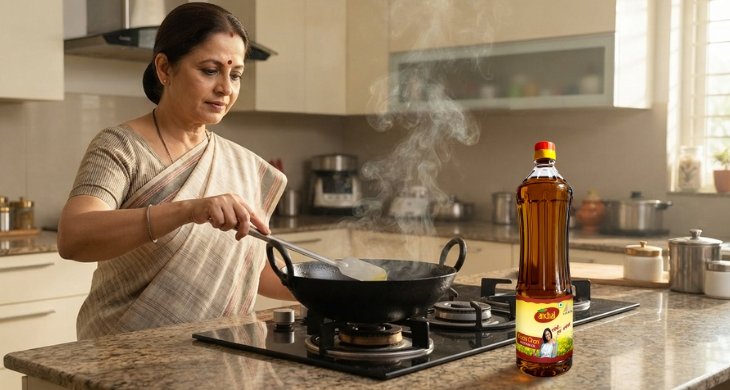
It wasn’t just tradition. There was a reason behind it.
If you grew up in a North Indian home, you’ve seen this countless times.
The pan goes on the stove.
Mustard oil is poured in.
Everyone waits.
The oil starts to shimmer… then a thin wisp of smoke appears.
Only then do the cumin seeds go in.
Nobody explained why.
It was simply “the right way to cook.”
Today, many people wonder if this is an old habit that should be avoided.
The truth?
Our mothers and grandmothers were doing something that food science now explains very well.
Why Mustard Oil Is Heated First
Fresh cold-pressed mustard oil has a naturally strong, pungent aroma.
That’s because it contains a natural compound called allyl isothiocyanate (AITC) the same compound that gives mustard and wasabi their sharp kick.
In raw form, this flavour can be quite intense.
When you briefly heat mustard oil until it just starts to smoke, part of that sharpness softens.
The oil becomes smoother, warmer and much better suited for everyday cooking.
You’re not “burning” the oil.
You’re preparing it.
That’s exactly why generations of Indian cooks have always followed this method.
Does Heating Destroy All the Goodness?
Not at all.
This is one of the biggest myths around mustard oil.
Briefly heating mustard oil until it reaches the smoke point doesn’t strip away everything that’s good in it.
Most of its healthy fats remain stable during normal cooking.
Some of the natural sharp compounds reduce and that’s actually the purpose of heating it.
The important word here is briefly.
Heat the oil until you see a light wisp of smoke.
Then lower the flame and start cooking.
Leaving oil smoking for several minutes is unnecessary for any cooking oil.
Why Food Tastes Better
Ever noticed how tadka made with properly heated mustard oil smells incredible?
There’s a reason.
When spices like cumin, mustard seeds, hing or dried red chillies hit hot oil, they instantly release their aroma.
This is called blooming the spices.
That fragrant oil then carries those flavours through the entire dish.
If the oil isn’t hot enough, the spices never fully release their flavour.
The result?
A dish that tastes flatter, even if you’ve used the same ingredients.
It Also Helps You Use Less Oil
Here’s something many people don’t realise.
Properly heated oil often makes food less greasy.
When vegetables or onions go into hot oil, they cook immediately instead of slowly soaking up oil.
So instead of adding extra oil for flavour later, you get better results with less.
That’s one reason traditional cooking techniques have stood the test of time.
Should You Heat Every Oil Until It Smokes?
No.
This is where many people get confused.
The smoking technique is mainly for cold-pressed mustard oil because of its naturally pungent compounds.
Refined sunflower oil and refined soybean oil don’t need this treatment.
For those oils, simply heat the pan, add the oil, wait until it shimmers and start cooking.
Taking them all the way to the smoke point doesn’t improve flavour—it only overheats the oil.
Different oils.
Different cooking methods.
Can You Use Mustard Oil Without Heating It?
Absolutely.
In fact, some dishes are better that way.
Raw cold-pressed mustard oil works beautifully in:
- Traditional pickles
- Chutneys
- Salads
- Finishing certain regional dishes
Its bold flavour is exactly what those recipes need.
For everyday sabzi, dal or tadka, however, briefly heating it first gives a much more balanced taste.
The Aroma Is a Good Sign
Many people worry when they smell the strong aroma of mustard oil while heating it.
In reality, that’s exactly what should happen.
That familiar sharp smell tells you the natural compounds in the oil are present.
It fades within a few seconds as the oil reaches cooking temperature.
If your mustard oil has almost no aroma at all, it may be heavily processed or simply not as fresh.
Good cold-pressed mustard oil should smell like mustard oil.
That’s its identity, not a defect.
Some kitchen traditions survive because they simply work. Heating mustard oil until it just begins to smoke isn’t an outdated habit.
It’s a cooking technique that softens the oil’s natural sharpness, helps spices release their flavour and prepares the oil for everyday Indian cooking.
So the next time you see that first thin wisp of smoke rising from the pan, remember –
You’re not just following tradition. You’re following a technique that generations perfected long before anyone explained the science behind it.