
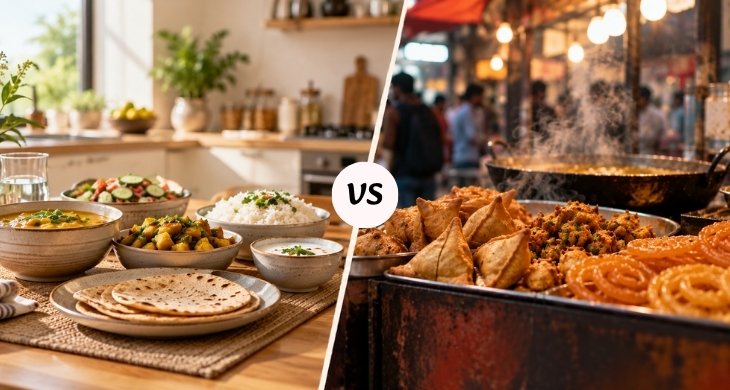
At home, you know what’s going into the kadhai.
One spoon for the sabzi.A little for the tadka.
Maybe you’ve even started measuring your family’s monthly oil consumption.
But here’s the oil most of us forget to count:
The oil we eat outside.
That samosa with evening chai.Friday’s office lunch.Sunday’s chole bhature.
The children’s after-school snack.It all counts.
Why Does Restaurant Food Often Feel Heavier?
There’s a reason restaurant food tastes different from everyday ghar ka khana.
Commercial kitchens need to cook quickly and consistently. Curries may use richer masala bases, fried foods require large kadhais of oil and butter or oil may be added at different stages to improve flavour and appearance.
That’s not necessarily a problem when you’re eating out occasionally.
The problem is when “occasionally” quietly becomes four or five meals every week.
There’s Another Oil You Can’t See
When you fry something at home, you know the condition of the oil.
Outside, you usually don’t.
You don’t know how long the frying oil has been in use or how it has been handled.
That doesn’t mean you should stop enjoying your favourite samosa.
It means where you eat matters too.
Look at the food and the establishment.
If fried food tastes stale, smells unusual, looks excessively oily or the frying oil itself appears very dark or repeatedly foams, choosing something else may be sensible.
Don’t Stop Eating Out. Balance It.
Had chole bhature for lunch? Dinner doesn’t need to be another rich meal.
Had pakoras with evening chai? Keep dinner simple.
Children had fried snacks after school? Dal, roti, sabzi or khichdi can easily balance the day.
You don’t have to balance every plate. Balance the whole day.
And when eating outside, mix things up.
Everything on the table doesn’t have to be fried or covered in a rich gravy.
The Oil You Don’t Pour Still Counts
That’s really the takeaway.
We pay attention to the oil bottle in our kitchen because we can see it.
But our bodies don’t separate ghar ka oil from bahar ka oil.
It all becomes part of what we eat.
So enjoy the samosa. Order your favourite chole bhature.
Go out with the family. Just remember:
The oil you don’t pour yourself still counts.
And when you’re back home, that’s where you have control over what you cook, how you cook it and the oil you choose for your family.
Cook with oils you trust at home. Ajanta’s range at ajantasoya.com/shop