
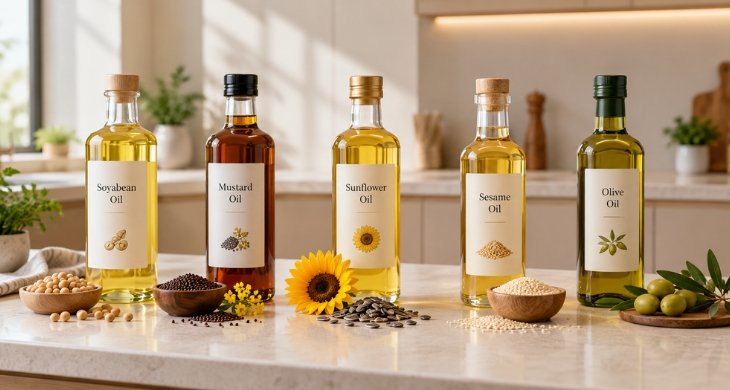
Travel across India and you’ll notice something interesting.
In Punjab and UP, you’ll smell mustard oil.
Reach Gujarat and groundnut oil becomes familiar.
Travel south to Kerala and suddenly it’s coconut oil.
And in Tamil Nadu, sesame oil has a special place in the kitchen.
So here’s the question:
Why didn’t all of India simply choose the same cooking oil?
The answer lies in our farms, flavours and centuries of cooking traditions.
North India: Mustard Oil
From UP and Bihar to Punjab and Haryana, mustard has traditionally been an important crop and naturally found its way into the kitchen.
But availability wasn’t the only reason it stayed.
Mustard oil’s strong aroma works beautifully with the bold spices of North Indian cooking.
Think achar, bharwa sabzi or a masala cooked slowly in mustard oil.
Replace it with a completely neutral oil and the same recipe can taste surprisingly different.
South India: Coconut & Sesame Oil
Travel to Kerala and the landscape itself gives you the clue.
Coconuts are everywhere.
Coconut oil naturally became part of local cooking and pairs beautifully with curry leaves, seafood and coconut-based preparations.
In Tamil Nadu, sesame or gingelly oil brings its own nutty flavour to traditional dishes.
Here, the oil isn’t simply used to cook the food. The oil is part of the flavour.
East India: Same Mustard Oil. Completely Different Story.
Bengal gives us an interesting twist.
Mustard oil appears again but it’s treated differently.
It can be used for cooking, marinating fish and in some preparations, even added in small quantities without cooking to preserve its sharp flavour.
It’s a great example of how two parts of India can take the same ingredient and build completely different food cultures around it.
West India: Groundnut Oil
Groundnuts grow extensively across Gujarat and parts of western India.
So it isn’t surprising that groundnut oil became a familiar part of the region’s kitchens.
Its relatively mild flavour also works well with the enormous variety of Gujarati food from everyday vegetables to farsan.
So Which Region Chose the Best Oil?
All of them. Because there isn’t one oil that’s perfect for every Indian recipe.
Our traditional kitchens understood something we’ve almost forgotten:
Choose your oil according to what you’re cooking.
Sometimes you want the distinctive flavour of mustard oil.
Sometimes you want the ingredients and spices to remain the hero, making a neutral refined oil more suitable.
India doesn’t have one cuisine. So why would it have just one cooking oil?
The next time you travel across India, don’t just ask:“What’s in this dish?”
Ask:“What was it cooked in?”
You may discover an entirely new part of the recipe.
At Ajanta, we make Cold-Pressed Mustard Oil, Refined Soybean Oil and Refined Sunflower Oil for exactly this reason because an Indian kitchen never cooks just one kind of food shop now