
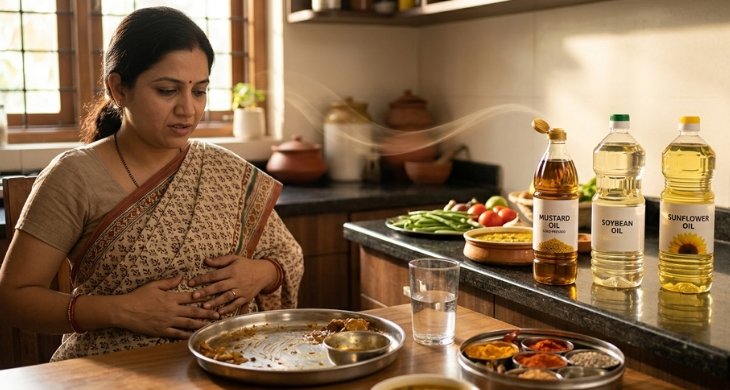
Nobody tells you this when you turn 40.
Your roti recipe doesn’t need to change. Your dal doesn’t need to change. Your family’s food preferences definitely don’t need to change.
But your body’s nutritional needs are changing, and the cooking oil you use every day may need a rethink.
Quietly, without much notice, your body’s requirements begin to shift. Yet the cooking oil sitting on your kitchen shelf may not have kept up with those changes.
This isn’t a scare piece. It’s a practical one.
Because the woman managing the kitchen at 40 is often taking care of everyone’s health except her own.
What Actually Changes After 40
Before we talk about oil, it helps to understand what’s happening in the body during this age.
- Hormonal shifts begin in the late 30s and continue through the 40s. Estrogen levels start declining, which affects how the body metabolises fat, manages cholesterol and maintains bone density.
- Metabolism slows not dramatically, but enough that the same meals that felt fine at 32 can start feeling heavier, harder to digest and harder to work off at 42.
- Cardiovascular risk increases gradually for women after 40, partly because estrogen which offered some protection to the heart is present in lower amounts.
- Inflammation becomes a more relevant concern. Chronic, low-grade inflammation is linked to joint pain, fatigue and a range of conditions that become more common in midlife.
None of this is alarming. All of it is manageable. And the cooking oil you use every day is a small but consistent lever you can pull.
What Your Oil Has to Do With Any of This
The fats in your cooking oil directly affect your cholesterol levels, your body’s inflammation response and how efficiently your cells function. Most Indian women over 40 are still using whatever oil their mother used or whatever was on offer at the store, without ever thinking about the fat profile of what they’re cooking in.
Here’s what to look for:
- Omega-3 fatty acids help manage inflammation and support heart health. Something that becomes increasingly relevant after 40. Refined soybean oil is one of the best plant-based sources of omega-3 available in a regular Indian kitchen.
- Monounsaturated fats (MUFA) support a healthy cholesterol balance. Raising good HDL cholesterol while not raising bad LDL. Cold-pressed mustard oil has a naturally good MUFA profile, which is part of why it has been a staple in North Indian cooking for generations.
- Vitamin E found in sunflower oil is an antioxidant that supports skin health and cellular protection, both of which become more relevant in the 40s.
- Saturated fat in your meals needs to be reduced. Vanaspati, dalda or heavy ghee usage should be reduced. Make sure it’s not eliminated completely.
The switch isn’t dramatic. It’s directional.
The 3 Oils Worth Keeping in Your Kitchen After 40
You don’t need six different oils. You need 3 each doing a specific job.
Cold-Pressed Mustard Oil : for your tadka, dal and everyday sabzi This is the oil that North Indian cooking was built on and for good reason. It’s natural fat profile. High in MUFA and moderate omega-3 makes it genuinely well-suited for the health needs of women in midlife.
Refined Soybean Oil : for frying and high-heat cooking When you need to deep fry, make puri or cook something at high heat, soybean oil’s stability and omega-3 content make it a better choice than many alternatives.
Refined Sunflower Oil : for baking, light cooking. Its high Vitamin E content and neutral flavour make it a good supporting oil for dishes where the oil is a background ingredient rather than a flavour carrier.
The One Habit That Matters More Than the Oil You Choose
Quantity. No oil, however good its fat profile, compensates for consistent overuse.
The body needs healthy fats, but the daily requirement for an adult woman is roughly 4 – 5 teaspoons of added oil total. Most Indian households use significantly more than this without realising it, largely because pouring has always been done by instinct rather than measure.
The 40s kitchen switch isn’t just about which oil is in the bottle. It’s about being a little more intentional about how much goes into the pan.
Better oil. A little more awareness of quantity.